Map and prioritise
Choose a repeated, high-friction process where improvement can be observed.
Business process automation
For SMEs that want less manual admin, better follow-up and connected systems without adding unnecessary complexity.
We map the work, remove unnecessary steps and automate the repetitive parts, with human checks wherever judgement, risk or customer relationships matter.
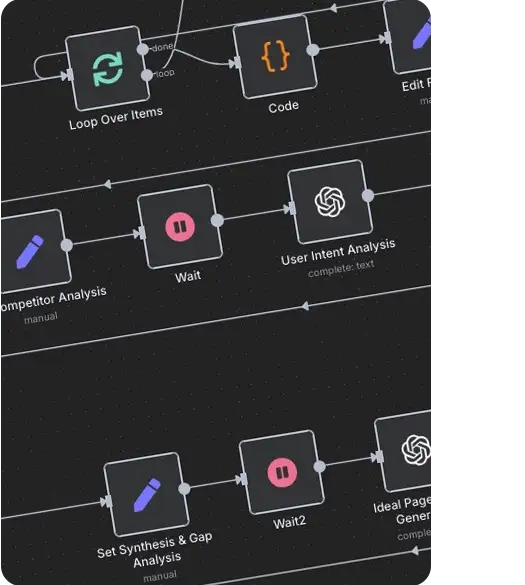
Where time disappears
The same data moves between forms, inboxes, spreadsheets and systems by hand.
Progress depends on one busy person noticing, chasing and updating each task.
Capable staff compensate for disconnected tools with extra checking and duplicated effort.
Start with the workflow
We look at what enters the process, who acts on it, what decisions are needed and where the work stalls. Automation is only added when it makes the process clearer and more dependable.
Capture useful details, route them correctly, acknowledge the enquiry and prompt timely follow-up.
Extract, organise and transfer routine information while flagging exceptions for review.
Keep people informed without relying on repeated manual messages or memory.
Bring together useful operational information and make the next action visible.
How we work
We can work with your website, forms, CRM, spreadsheets, accounting software, email platforms and sector-specific tools.
Choose a repeated, high-friction process where improvement can be observed.
Connect the right tools, test normal and exceptional cases, and retain sensible human checks. GetRevues.ai shows how guest signals can become earlier, human-led action.
Make ownership clear, monitor the workflow and refine it using real operational feedback.
Direct answers
Useful automation starts with a clear process, not a promise that AI can do everything.
It can help with enquiry handling, lead qualification, reminders, document processing, reporting, CRM updates, email follow-up and data entry. The best use cases are repetitive tasks with a clear process.
Simple workflows can often be implemented in one to two weeks. More complex multi-step processes may need four to eight weeks, depending on tools, data, risk and testing.
No. The aim is to remove repetitive work so people can focus on service, sales, judgement and problem-solving.
Yes. Reusing systems that already work is often faster and more commercially sensible than replacing everything.
Start with one useful workflow
Bring us a repeated task, a messy handover or a process that relies too heavily on memory.
Book an automation review